EyeSeeCam

EyeSeeCam

EyeSeeCam is a head-mounted gaze-driven camera that is controlled by eye movements. The video files contain an approximation of the retinal content and are recorded to the hard disk of a portable laptop computer.

EyeSeeCam is a unique camera system that is controlled with the eyes. It is the only system that can record what the eyes of its user really see. Unrestricted user mobility and field of view as well as the utilization of biological image stabilization reflexes are main benefits of EyeSeeCam. Imagine to see through the eyes of:

  • a surgeon who uses EyeSeeCam to film an operation for documentation and teaching purposes
  • a scientist who uses EyeSeeCam to examine human natural visual exploration in the wild

EyeSeeCam combines and enhances two technologies:

  1. An ultra-mobile eye tracker that measures 3D eye position at unprecedented frame rates of up to 600 Hz.
  2. A camera motion control unit with servo motors that steer a head-mounted camera to the target of gaze.

An off-the-shelf notebook records video files with resolutions of up to 752×480 pixels to hard disk. A novel picture-in-picture functionality combines the image of the gaze camera with another image from a wide-angle scene camera. Just as a magnifying lens, this “hybrid perspective” gives the impression of a sharp image at the target of gaze.

Video-Oculography (VOG)

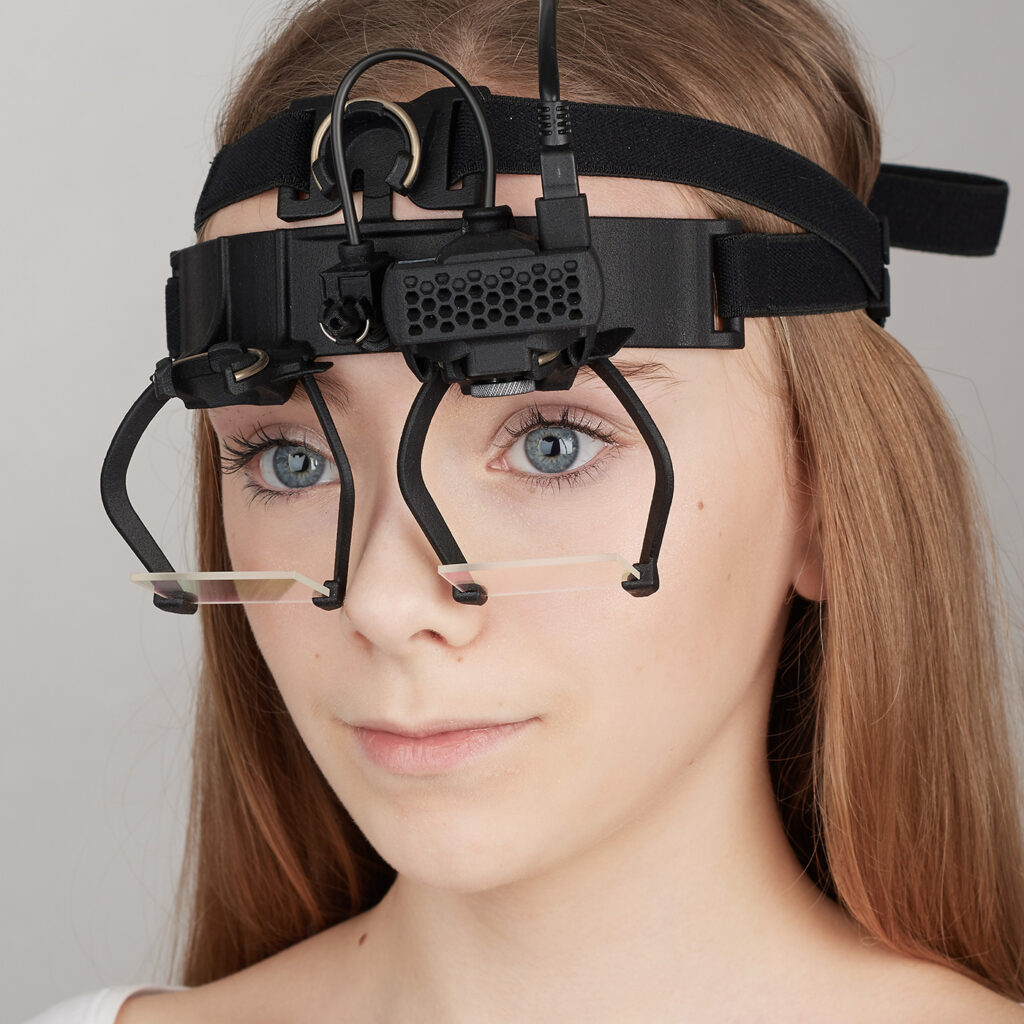
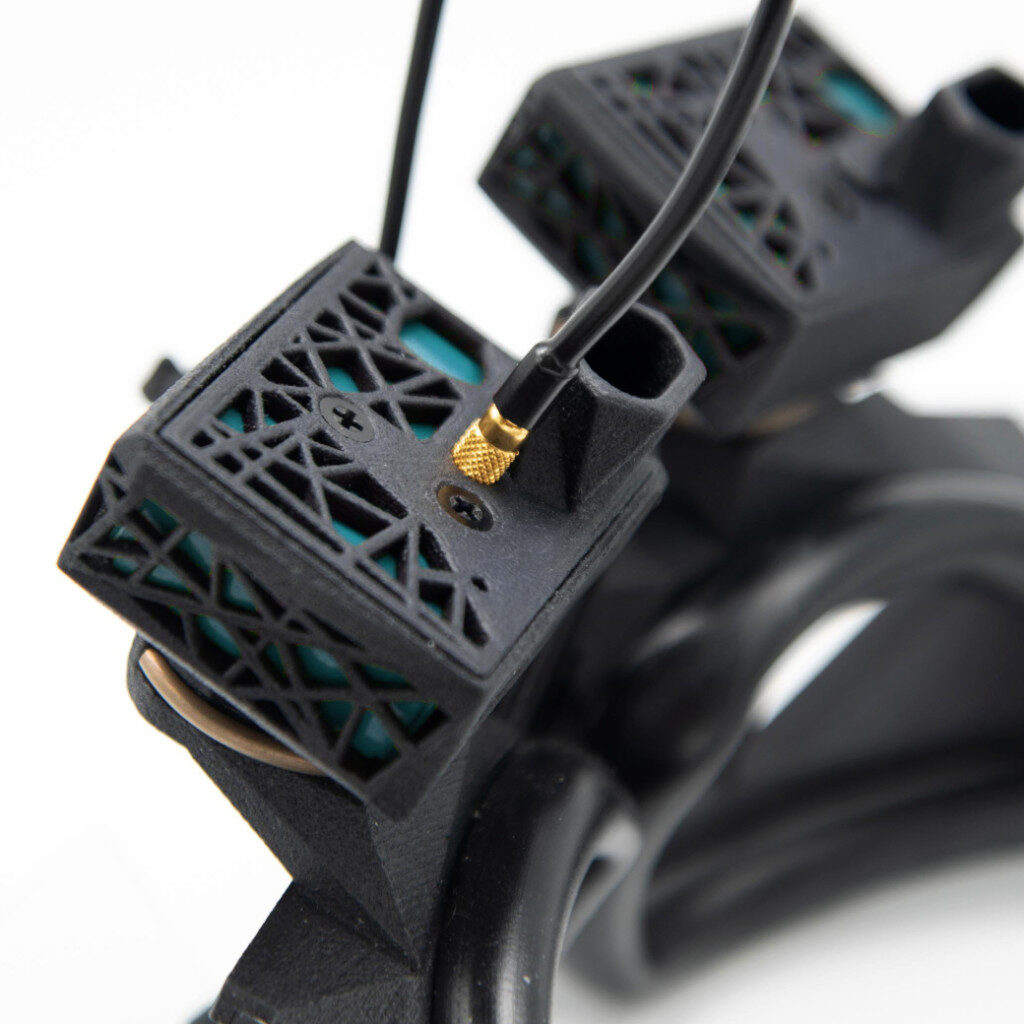
EyeSeeCam VOG setup in a lightweight design that is suited for binocular eye movement analysis under mobile or bedside conditions. Free viewing is ensured by laterally attached digital cameras and semi-translucent hot mirrors. Head movements are measured by miniaturized inertial sensors that are integrated into the cameras (not visible).

VOG, also known as video- nystagmography (VNG), is commonly used for measuring eye movements in the examination and diagnosis of vestibular (balance) disorders.

EyeSeeCam VOG is unique in that it offers a combination of unprecedented functionalities in a lightweight design:

  • 3D examination of horizontal, vertical, and torsional eye movements
  • real-time data analysis with 4 ms latency
  • digital cameras with frame rates of up to 600 Hz
  • spatial resolution of down to 0.01 deg (RMS)
  • battery-powered laptop mobility
  • optional AD/DA interface for external synchronisation
  • optional recording of head movements by an integrated 6-DOF inertial measurement unit
  • head-centric calibration with integrated laser projector
  • WiFi remote control

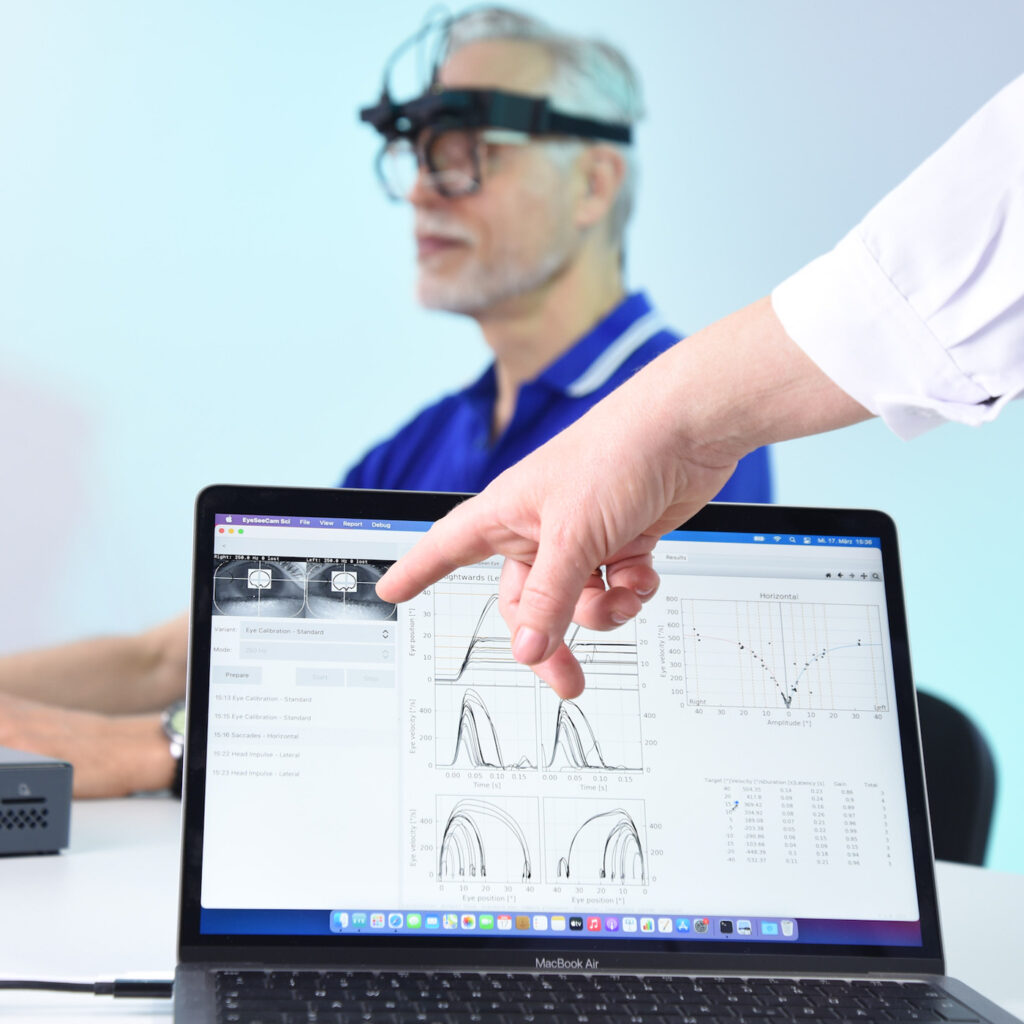
EyeSeeCam VOG now takes, among others, a number of objective vestibular tests from the laboratory to the bedside, like head impulse test, saccade metrics, or caloric irrigation test.

Frequently Asked Questions

  1. Is it easy to transform data to MATLAB format?
    Yes, it´s not only easy, the data IS in MATLAB format.
  2. Can the VOG record eye movements in darkness?
    Yes, it´s built with this application in mind. The illumination consists of infrared (IR) LEDs and the cameras are very sensitive to IR light. An additional IR filter blocks any visible light from reaching the cameras.
  3. Can EyeSeeCam record additional analog signals at the same time?
    Yes, there are two optional AD/DA converters of different price and quality that are suited for the synchronous recording of other analog and digital signals.
    The 2008 version of the gaze-driven camera "EyeSeeCam". The eye movement is tracked by cameras attached on both sides using infrared reflecting hot mirrors. The gaze-driven camera follows saccades, smooth pursuit, and stabilization movements, caused by the vestibulo-ocular reflex.
  4. Can EyeSeeCam additionally monitor head rotation, head linear motion, and their timing?
    Yes, EyeSeeCam has two options for recording linear and rotational (6 DOF) head motion synchronous with the camera frame rate (up to 600 Hz):
    • Integrated inertial 6 DOF sensors measure translational accelerations and rotational velocities, both in 3D.
    • A third scene camera above the nose measures absolute head position and orientation with the same frame rate as the synchronized eye tracker cameras. The resulting head pose vector is given relative to an array of 5 IR LEDs.
  5. Can the system be used for subjects with glasses?
    Rather not, but if the glasses are small enough, they might fit beneath the eye tracker / VOG goggles. This has to be tested for each subject individually. Contact Lenses are no problem.
  6. I have a cheap Windows/Mac/Linux PC. Can I use this PC instead of the EyeSeeCam laptop?
    Maybe, if you manage to install the software on your own (without support from EyeSeeCam). However, we recommend to use our pre-installed laptop.
  7. On what type of computer system (PC/Mac - Windows/Mac OS/Linux) does EyeSeeCam run?
    Per default, EyeSeeCam comes pre-installed on a MacBook (Pro as an option) with MacOS as the OS. Our software also runs well on Linux and we have an experimental Windows version. If something else is required, please refer to the previous question.
  8. Why does EyeSeeCam use MacBooks?
    EyeSeeCam is a mobile system that uses up to 4 FireWire (not USB) cameras for the eye tracker / VOG. These cameras also need the power supply from the FireWire bus. A laptop is required for mobility, but there are just a few laptops around that give access to their power supply over a 6-pin FireWire connector. We tested all of them but MacBooks proved to have the most stable FireWire support.

Downloads and Links

Contact

University Hospital Munich
Center For Sensorimotor Research
Dr. Erich Schneider
Marchioninistr. 23
81377 Germany

Phone: +498970954830
eMail: info (at) eyeseecam.com

If not otherwise stated, for all text and pictures:
Copyright 2004-2009 EyeSeeCam.com